Mini excavators mean big decisions.
Walk onto any job site and count the machines. Odds are strong mini excavators are doing the real work while bigger iron sits idle. Seven models of mini excavators are worth a hard look in 2026 — gas and diesel, 1 ton to 6.6 ton, each with a job it was born for.
Simple math for mini excavators. Wrong machine costs more than the right one.
Table of Contents
- The 1 Ton Class Where Most Buyers Should Start
- TYPHON Terror Propact Series Spec Sheet Meets Reality
- Gas vs Diesel The Honest Comparison
- The 3 Ton Sweet Spot
- The 6.6 Ton Top End When Small Stops Working
- Attachments The Hidden Budget Line
- Buying Process Three Moves No Drama
- Final Word Pick the Job Then the Machine
The 1 Ton Class Where Most Buyers Should Start
Gate width decides everything. Measure it before reading further.
A 1-ton class of mini excavators fits through a 36-inch opening. That single number eliminates half the machines on the market. Homeowners dig trenches, clear small stumps, run irrigation lines — done. No trailer needed if a half-ton pickup sits in the driveway.
Gas engines rule here. Briggs & Stratton or Honda power, pull-start or key, cheap to service, parts at any small engine shop. Diesel in this size of mini excavators costs more upfront and the torque advantage barely shows up in light digging.
Here is what the spec sheets for mini excavators never tell you. A 1-ton machine on soft ground digs faster than a 3-ton machine on the same ground — less weight, less sinking, less track spin. Turf damage drops too. Landscapers who work established yards figure this out fast and stop hauling the big unit to small jobs when mini excavators can do it.
Extra insight nobody prints: rental yards price 1-ton mini excavators at roughly the same daily rate as 3-ton machines. If a project runs past four days, buying starts beating renting — and the resale market for 1-ton gas mini excavators stays stubbornly strong because every landscaper wants one.
Nobody misses the bigger machine on a backyard job.
TYPHON Terror Propact Series Spec Sheet Meets Reality
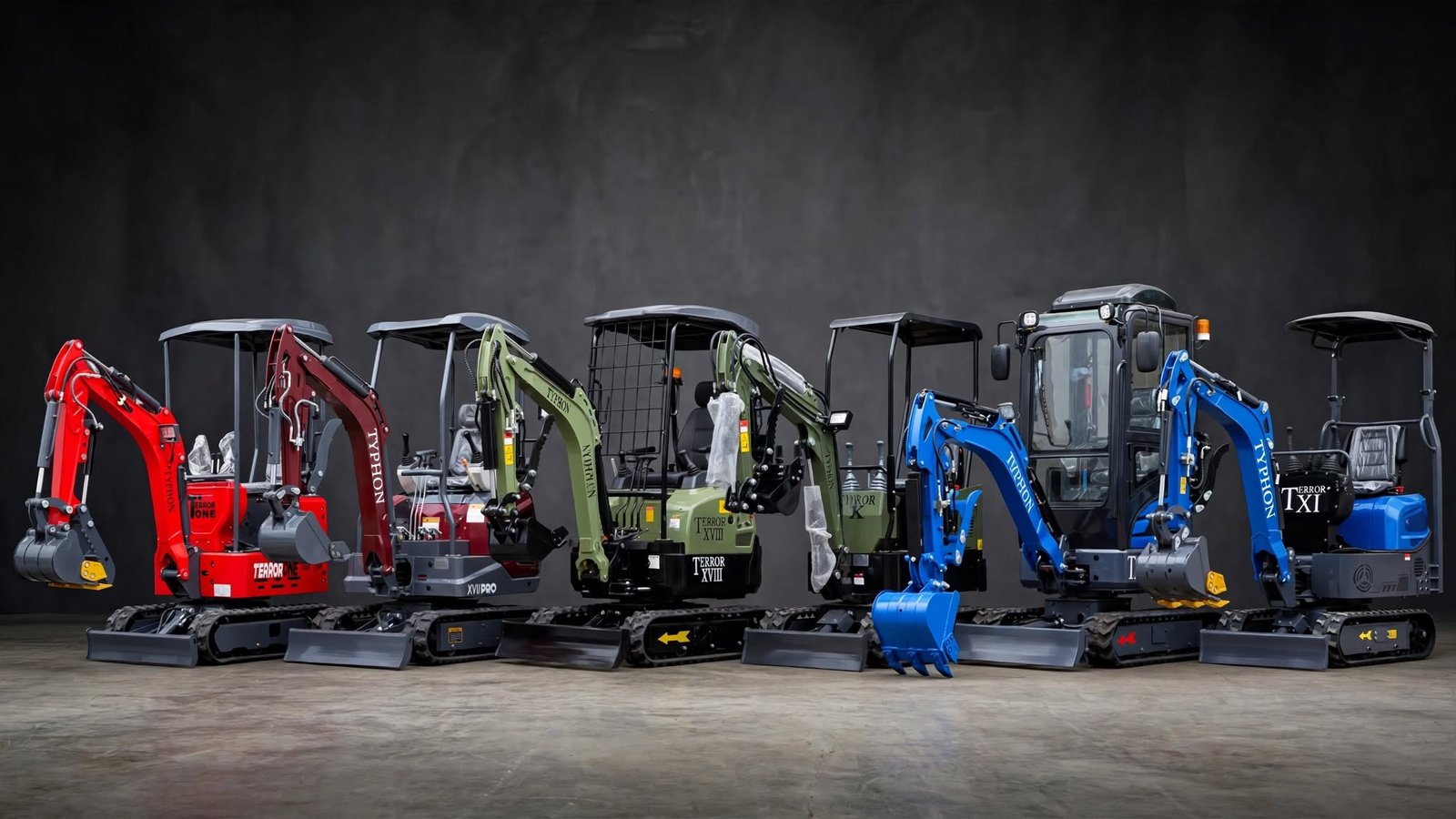
The Terror line of mini excavators carries the specs buyers actually ask about. Propact hydraulics, compact footprint, attachment-ready coupler.
Gas and diesel options in the same family. Smart move. Pick the engine after picking the job, not before.
One-line verdict: built for people who want a machine, not a project.
Cycle time deserves a mention here. Most mini excavators reviews quote breakout force and stop. Breakout force tells you what the bucket can pry loose. Cycle time tells you how fast the boom returns after a dump. Daily productivity lives in that second number.
Extra insight: ask for cycle time before signing anything. Dealers rarely volunteer it, and the gap between a fast machine and a slow one shows up around hour six of a ten-hour day — exactly when the crew stops caring about spec sheets and starts caring about finishing.
Gas vs Diesel The Honest Comparison
Gas wins on three counts. Lower purchase price. Quieter operation. Simpler cold starts.
Diesel mini excavators win on two that matter long-term. Torque under load, and engine life. Kubota, Yanmar, Perkins diesels run daily commercial shifts without complaint. A gas unit doing the same work ages faster.
Run the numbers. Occasional weekend use — gas. Daily commercial digging — diesel.
Fuel cost is the wrong comparison, by the way. Over five years, resale value separates these mini excavators far more than fuel does. Diesel mini excavators hold value better in commercial markets. Gas mini excavators hold value better in residential markets. Match the engine to the buyer who will eventually purchase it from you.
Extra insight: diesel engines tolerate dirty fuel better than gas engines tolerate stale fuel. A machine that sits for months favors diesel — old gas gums up carburetors, old diesel mostly just burns. Seasonal users with long idle stretches should weigh that before chasing the cheaper sticker.
Buy for the resale. Dig for the job.
The 3 Ton Sweet Spot
Three tons is the working man’s number for mini excavators. Big enough for real trenching, small enough for a trailer.
Most landscaping crews land here. Pool digs, foundation work, drainage — a 3-ton diesel handles all of it without babysitting. Operators climb off after eight hours and still feel human, which is more than can be said for the bigger classes.
Attachments change the math. Add a thumb and the machine becomes a grabber. Add an auger and it becomes a post-hole crew. One machine, ten jobs — that is not marketing fluff, that is the actual economics.
Check attachment compatibility before buying the machine, not after. Coupler styles vary, and a $400 adapter turns a $2,000 attachment into a paperweight. Pin-on versus quick-coupler — decide first.
Extra insight: the 3-ton class of mini excavators holds the deepest used inventory of any size bracket. That cuts both ways. Buyers get choice and negotiating room. Sellers get competition. If resale matters within three years, buy the brand with the strongest dealer network in your region, not the lowest sticker.
Simple math. Attachments outlive machines.
The 6.6 Ton Top End When Small Stops Working
Six and a half tons crosses into serious dirt for mini excavators. Commercial grading, roadwork prep, large-scale clearing.
Diesel only at this size. No exceptions worth discussing. Kubota and Yanmar powerplants dominate for good reason — torque curve stays flat under load.
Trailer requirements jump here. CDL territory in some states. Check before falling in love with a listing.
Weight class affects delivery cost more than purchase price. A 6.6-ton unit ships on a different trailer class than a 3-ton. Free shipping sounds identical on paper. It rarely is at the top end.
Extra insight: at this size, hydraulic flow ratings matter more than horsepower. A lower-horsepower machine with higher flow runs attachments better than a bigger engine starved of hydraulics. Read the flow spec first. Horsepower sells machines. Flow runs them.
Read the fine print. Twice.
Attachments The Hidden Budget Line
Buckets, thumbs, augers, breakers. The attachment list decides what mini excavators can actually do.
Standard bucket — digging. Thumb — grabbing and loading. Auger — fencing and planting. Breaker — concrete and rock.
Budget 15–25% of machine price for attachments. Skip this line and the excavator becomes a very expensive shovel.
Most buyers over-attach at purchase and under-attach later. Start with bucket and thumb. Add tools when a job demands them. Attachment rental exists for the one-time jobs — use it.
Extra insight: attachment steel quality varies wildly between brands, and the difference shows up in the teeth. Cheap bucket teeth wear round in weeks. Hardened teeth last seasons. Ask what the teeth are made of before asking the price. Replacement teeth cost less than replacement buckets — but only if the bucket was worth re-toothing in the first place.
Buy the machine. Rent the oddball tool.
Buying Process Three Moves No Drama
Find the right mini excavators. Filter by size, engine, cab. Compare live prices.
Order. Checkout routes to the official manufacturer store.
Delivery. Ships from Commerce, California to 48 states. Free shipping, one-year warranty.
That is the whole process. No middleman markup, no showroom pressure.
Warranty terms differ between machine and attachments. One-year coverage on the mini excavators does not automatically cover the bucket or breaker. Ask for both in writing before checkout — a two-minute question that saves a two-month argument.
Extra insight: delivery windows stretch in spring and early summer, when every landscaper in the country orders at once. Order in late winter for spring work. The machine arrives before the rush, the price holds, and the first job pays for the trailer.
Get it in writing. Always.
Final Word Pick the Job Then the Machine
Seven machines. One decision tree.
Measure the gate. Count the digging days. Match the engine. Budget the attachments. Confirm the warranty.
Do those five things and the choice makes itself. Gas for weekends, diesel for daily work, 1 ton for backyards, 6.6 ton for commercial dirt.
The right mini excavators disappear into the job. The wrong mini excavators become the job.
Simple math.
Our Business Partner